

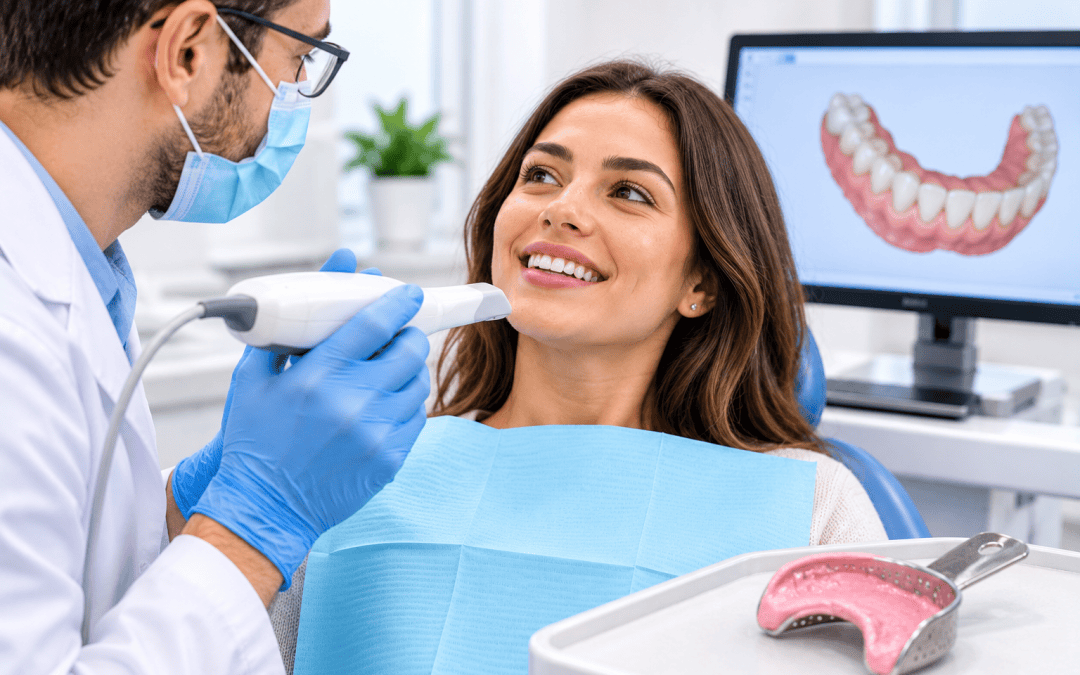
Choosing the right dental treatment often involves more than examining your teeth. Dr. Jonathan Kim, a general dentist with expertise in digital esthetic smile design and 3D-printed veneers, uses digital scans to capture a detailed model of your teeth and bite. These models help plan restorations, orthodontic treatment, and other dental procedures. Traditionally, this meant placing a soft impression material in a tray and asking patients to bite down until it hardened. Today, digital scanners offer a more accurate and more comfortable alternative.
At Sunny Dental Care, patients from SoHo and nearby Tribeca can discuss their dental needs and learn how digital scanning works. Digital scans make treatment planning more precise, comfortable, and efficient. But how do they compare with traditional dental impressions? Understanding the differences can help you know what to expect at your appointment.
What Are Traditional Dental Impressions?
Traditional dental impressions are physical molds of your teeth and surrounding oral structures. When traditional impressions are required, the treating dentist places an impression tray filled with a soft material, such as alginate or silicone, over your teeth.
You will be asked to hold the tray in place while the material sets. Once it hardens, the dentist removes it and sends the impression to a dental laboratory or uses it to create a physical model.
These impressions have been used in dentistry for many years and can be suitable for several procedures, including crowns, bridges, dentures, and orthodontic appliances.
However, some patients find the process uncomfortable. The impression material may trigger a gag reflex, create a feeling of pressure, or leave an unpleasant taste. The material also needs to be handled and stored carefully to maintain its shape.
What Are Digital Dental Scans?
Digital dental scans use an intraoral scanner to capture images of your teeth and gums. Instead of using a tray filled with impression material, your dentist moves a small handheld scanning device around your mouth.
The scanner captures multiple images and combines them to create a detailed three-dimensional digital model. Dr. Jonathan Kim can review this digital model on a screen and use it to support treatment planning.
Digital scans may be used for several dental applications, including:
- Crowns and bridges: To capture the shape and position of teeth when planning restorations.
- Clear aligners: To create digital models used in orthodontic treatment planning.
- Veneers: To assess tooth shape and support the design of cosmetic restorations.
- Dental implants: To assist with planning restorations supported by dental implants.
You can learn more about the treatments available at Sunny Dental Care on our general dentistry page.
Digital Scans vs. Traditional Impressions: Key Differences
Both methods help dentists capture information about your teeth. However, they differ in how the information is collected and used.
1. Accuracy and Detail
Digital scans are more accurate than traditional impressions. An intraoral scanner captures many images of your teeth and gums and combines them into a precise three-dimensional model, with no physical material involved.
Traditional impressions depend on a material that has to set in your mouth. Distortion, air bubbles, movement while the material sets, and changes during transport to the laboratory can all affect the final model. Digital scanning avoids these sources of error. Because the scan appears on screen as it is captured, Dr. Jonathan Kim can check the detail right away and rescan any area before you leave the chair.
This level of accuracy supports a better fit for crowns, bridges, veneers, clear aligners, and implant restorations.
2. Patient Comfort
Traditional impressions require a tray and impression material to remain in your mouth while the material sets. Some patients experience gagging, pressure, or discomfort during this process.
Digital scanning does not require a full impression tray. The smaller scanner is moved around the mouth, which many patients find easier to tolerate.
3. Time and Convenience
With traditional impressions, the material needs time to set before the tray can be removed. If the impression contains an error, the dentist may need to repeat the process.
Digital scans are displayed on a screen as they are captured. Your dentist can review the images immediately and rescan an area if necessary.
4. Digital Communication With the Dental Laboratory
Digital files can be shared electronically with dental laboratories. This can simplify communication between the dental team and laboratory technicians when planning restorations.
Traditional impressions generally need to be physically transported, which adds another handling step.
5. Environmental Considerations
Digital scanning can reduce the need for disposable impression materials and trays in appointments where a digital scan is suitable. However, the overall environmental impact also depends on the equipment, materials, and laboratory processes involved.
Are Digital Dental Scans Always Better?
Digital scanning offers several advantages, but it may not be the most appropriate option for every patient or procedure.
The suitability of a scan depends on factors such as the treatment being planned, the condition of the teeth and gums, and the equipment available. In certain situations, traditional impressions may still be recommended.
Dr. Jonathan Kim can assess your scanning requirements and explain which method may be appropriate for your treatment.
How Are Digital Scans Used in Cosmetic and Orthodontic Dentistry?
Digital scans can support treatment planning in both cosmetic and orthodontic dentistry.
For example, when considering veneers, Dr. Jonathan Kim may use a digital model to evaluate tooth shape, spacing, and alignment when planning cosmetic treatment. This information can help with planning the proposed restoration.
If you are considering clear aligners, digital scans can capture the current position of your teeth. These records may be used as part of the process of planning tooth movement.
Learn more about cosmetic dentistry at Sunny Dental Care or explore our Invisalign treatment information.
Digital scans may also contribute to planning restorations supported by dental implants.
What Should You Expect During a Digital Scanning Appointment?
A digital scanning appointment is generally straightforward.
- Initial examination: Dr. Jonathan Kim examines your teeth and determines which digital records are needed.
- Scanning: A small handheld scanner is moved around your teeth to capture digital images.
- Image review: The scanner creates a three-dimensional model that can be viewed on a screen.
- Treatment planning: Dr. Jonathan Kim reviews the scan and discusses how it may be used for your recommended treatment.
The process may take a few minutes, depending on the number of areas being scanned and the complexity of the case.
Frequently Asked Questions
Are digital dental scans more accurate than traditional impressions?
Yes. Digital scans are more accurate than traditional impressions. They capture fine detail directly, without impression material that can distort, shrink, or shift as it sets. Your dentist can also review the scan immediately and rescan any area, which helps produce restorations and aligners that fit well.
Do digital dental scans hurt?
Digital scanning is generally comfortable. It is non-invasive and does not involve needles or drilling. A small handheld scanner is moved around your teeth to capture images. Some patients may feel mild fatigue if it is hard to keep their mouth open during the scan.
How long does a digital dental scan take?
The scanning process may take a few minutes, depending on the number of teeth being scanned and the complexity of the case. Dr. Jonathan Kim can provide an estimate during your appointment.
Can digital scans be used for Invisalign treatment?
Yes. Digital scans can capture the position of your teeth and help support clear aligner treatment planning. Your dentist or orthodontic provider will determine whether Invisalign is suitable for your needs.
Are traditional dental impressions still used?
Yes. Traditional impressions remain useful for certain dental procedures. Your dentist will select the appropriate method based on the treatment requirements and your individual oral health.
Digital Dental Scans at Sunny Dental Care in SoHo
Digital dental scans can support treatment planning for restorations, orthodontic appliances, and cosmetic procedures. The choice between digital scans and traditional impressions depends on the procedure and individual clinical requirements.
At Sunny Dental Care, Dr. Jonathan Kim, a general dentist with expertise in digital esthetic smile design and 3D-printed veneers, can assess your dental needs and explain whether digital scanning is suitable for your planned treatment. Schedule a consultation at our SoHo office to learn more about the scanning process and your options.
Call Sunny Dental Care at (212) 842-5300 or book online at https://www.sunnydental.us/. Our office is located in SoHo, Manhattan, NY, serving patients from nearby Tribeca.
Recent Comments